

In April 2004, a guest editorial titled The State of Star Wars Gaming sparked the sort of argument Star Wars fans have always been exceptionally qualified to have: were the new games finally becoming better, or had something been lost along the way? The follow-up article was almost more interesting than the original piece. Some readers pointed back to X-Wing, TIE Fighter and Jedi Knight as proof that Star Wars games had already been excellent for years. Others saw Knights of the Old Republic and Battlefront as evidence that the license was finally becoming something bigger.
Twenty-two years later, the question is worth asking again, because 2026 has given us a very peculiar answer.
Star Wars Zero Company arrived in August as a turn-based tactics game about building a squad, managing relationships and deciding who is worth risking on the next operation. Then, in October, Galactic Racer turned up and asked us to forget tactical cover for a moment and instead consider the aerodynamic qualities of going much too fast through places where sensible people would not build a racetrack.
That is healthy. More importantly, it feels familiar. The best periods of Star Wars gaming have rarely been defined by one dominant style of game. They have been defined by the feeling that the next box on the shelf could contain almost anything.
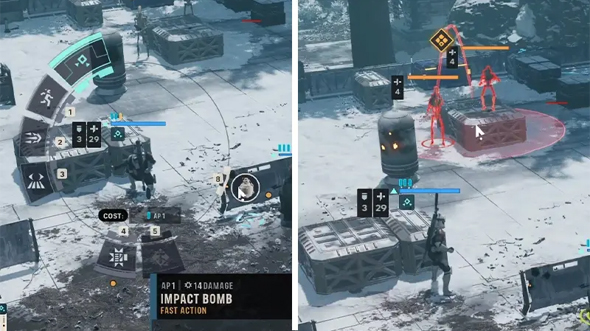
Zero Company turns Star Wars into a tactical language of cover, risk and operator choice. Image source: EA Help / Electronic Arts.
2026 remembers that Star Wars is not a genre
Modern Star Wars games are technically better than the games of thirty years ago in almost every obvious way. Controls are smoother. Animation is better. Voice acting is more consistent. Accessibility options would have looked like sorcery to anyone trying to configure a joystick in 1994. Worlds can be larger, characters can be performed with far more nuance, and a podracer no longer needs to be represented by approximately seven polygons and optimism.
But better technology does not automatically produce a stronger game. The great LucasArts period understood something very simple: start with the fantasy, then choose the genre that makes that fantasy playable.
If the fantasy was flying an X-wing, the answer became a space-combat simulator. If it was serving the Empire, TIE Fighter took many of the same systems and changed their context until military efficiency itself became part of the role. Dark Forces asked what Star Wars would look like as a first-person shooter. Knights of the Old Republic borrowed the structure of a computer RPG. Republic Commando became a squad shooter. Empire at War became a strategy game. Episode I: Racer became a racing game. Star Wars Galaxies became a place where, for a while, somebody could spend an evening running a cantina instead of saving the galaxy.
The old game list is almost comical in its variety. There are flight sims, shooters, strategy games, RPGs, MMOs, racing games, educational titles, arcade games and several experiments that probably seemed like excellent ideas at three in the afternoon and slightly stranger by dinner. A full chronology of Star Wars releases makes the same point from another angle: the license has spent decades refusing to fit into one box.
That variety matters because Star Wars works unusually well as a setting. It does not need every game to behave the same way. Zero Company is a good current example. Its Star Wars identity does not come from bolting lightsabers onto a generic action game. It comes from translating the Clone Wars into decisions: positioning, risk, squad composition, bonds between operators and, if the player enables it, the possibility of losing people permanently. Galactic Racer does something similar from the opposite direction. It takes speed, dangerous machinery, Outer Rim spectacle and the legacy of podracing, then builds the game around those things.
Neither game needs to be the definitive Star Wars game. That is precisely why both are useful.
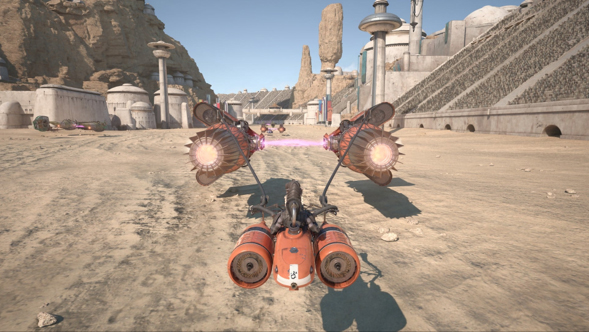
Galactic Racer works because it commits to being a racing game first: speed, handling, routes and risk do the storytelling. Screenshot source: Pure Xbox.
Are the old games actually better?
Nostalgia is a dangerous piece of hardware. It has excellent battery life and absolutely no quality-control department.
It is easy to remember TIE Fighter as flawless because nobody remembers the evening spent fighting DOS memory management. It is equally easy to look at a modern game running at high resolution, filled with cinematic performances and enormous environments, and assume progress has solved everything.
The fairer comparison is not graphics against graphics. It is clarity of purpose against clarity of purpose.
TIE Fighter still matters because its systems make the Imperial fantasy legible. Power management, targeting, shields on some craft and the terrifying absence of them on others all tell the player something about how this military machine thinks. The game does not merely show an Imperial cockpit. It teaches the player to behave inside one.
That is the standard modern games should compete with. A game like Jedi: Survivor can deliver movement, combat and cinematic storytelling that a 1990s developer could barely have imagined. Outlaws can build spaces that feel physically inhabited in a way that early adventure games could only suggest. But older games were often more willing to let one strong mechanical idea dominate the entire experience.
The danger for modern licensed games is not that they are worse. It is that expensive production can encourage them to become broader, safer and more familiar. When every large game needs exploration, crafting, progression systems, skill trees, collectibles and a map large enough to frighten cartographers, the license can start serving the format instead of the format serving the license.
Zero Company and Galactic Racer are encouraging because they move in the other direction. They are specific. Thirty years later, that may be the most LucasArts-like thing about them.
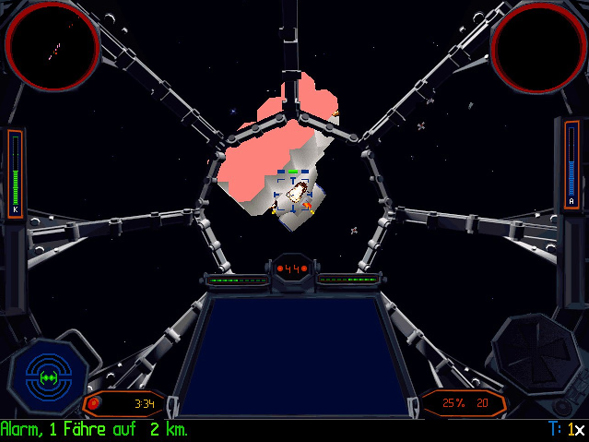
TIE Fighter remains a useful benchmark because its systems do more than simulate a ship: they explain what it feels like to serve the Empire. Screenshot source: PC Games.
So how many Star Wars games should there be?
There is no magical number, but one new Star Wars game every several years is too little for a universe this broad, while six rushed releases in twelve months would merely give everyone new reasons to argue online.
My ideal rhythm would be two or three meaningful releases in a year, but at different scales. One could be the large cinematic game that receives the blockbuster budget. Another could be a focused genre game such as Zero Company or Galactic Racer. A third might be something smaller and stranger: an adventure game, a VR experiment, a tactical spin-off, a management game or the sort of idea that does not require five hundred developers and a map containing seventeen kinds of shrubbery.
The important thing is not volume. It is separation. Star Wars is large enough to support a racing game without that racing game needing to become an open-world RPG. It can support a tactics game without adding real-time lightsaber combat because someone in a meeting becomes nervous about turn-based battles. It can support a narrative game in which the climax is a conversation rather than a Death Star exploding for occupational reasons.
The modern Lucasfilm Games model is actually well suited to this. Even around the turn of the millennium, LucasArts leadership was already talking about partnerships with outside specialists such as BioWare and Verant as a way to get the best people for a particular kind of game. Years later, the Lucasfilm Games name was revived around a model that increasingly relies on collaboration with specialist studios. That is potentially much healthier than asking one internal studio to be brilliant at everything.
The Star Wars SCUMM game that technically existed, but not really
Then there is the strange empty chair in Star Wars gaming history: the LucasArts graphic adventure.
Technically, Star Wars did touch SCUMM. Rebel Assault used the SCUMM engine in a heavily repurposed form, and modern ScummVM work has made that connection wonderfully explicit. It shares technology with the adventure-game lineage, but calling Rebel Assault a traditional SCUMM adventure is a little like calling a speeder bike a chair because both contain a seat.
It is true. It is also not what anybody means.
What Star Wars never received was its Monkey Island, its Day of the Tentacle or its Sam & Max Hit the Road: a proper graphic adventure built around observation, dialogue, inventory puzzles and the pleasure of clicking on something purely because the designer clearly hoped you would.
This is odd because Star Wars is full of adventure-game material. Droids misunderstand instructions. Smugglers lie. Bureaucrats obstruct. Cantinas are packed with people who know one useful fact and would prefer not to share it. Half the machinery in the galaxy already looks as though the solution to a puzzle involves attaching the wrong cable to the wrong socket and then blaming an astromech.
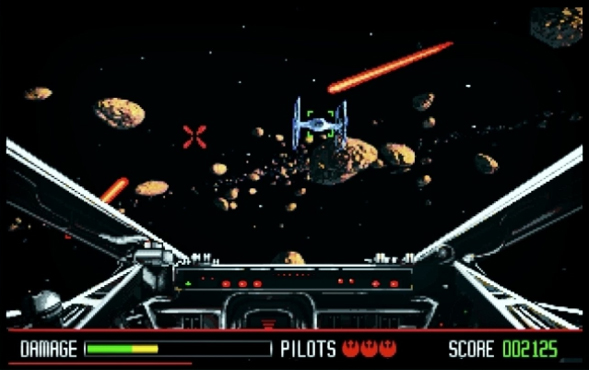
Rebel Assault is the historical wrinkle: Star Wars did technically use SCUMM technology, just not in the point-and-click sense people normally mean. Screenshot source: PC Games.
LucasArts even came close. Hal Barwood later described a proposed Star Wars adventure called The New Emperor, set after the original trilogy, with C-3PO as the player's avatar. The idea was to move the universe forward and use Threepio as an inconspicuous spy. It never entered production. Barwood said adventure-game sales at the time were poor, and the project joined the enormous museum of fascinating LucasArts games that exist mainly in sentences beginning with “apparently they once considered...”
C-3PO as the lead of a graphic adventure is, incidentally, exactly the kind of idea that becomes better the longer one thinks about it. He can talk to almost anyone, open almost nothing, hates danger, complains constantly and has spent most of his life being dragged into puzzles against his will. Ron Gilbert could have retired immediately.
Would such a game work now? I think it could, especially if nobody tried to make it a $200 million production.
A modern Star Wars adventure could live comfortably at a smaller scale, the same way Lucasfilm Games has been able to reconnect with its adventure heritage through Return to Monkey Island. It could be funny without becoming parody, character-driven without needing galaxy-ending stakes, and mechanically different from everything else on the current slate. Most importantly, it would fill a space rather than compete for one.
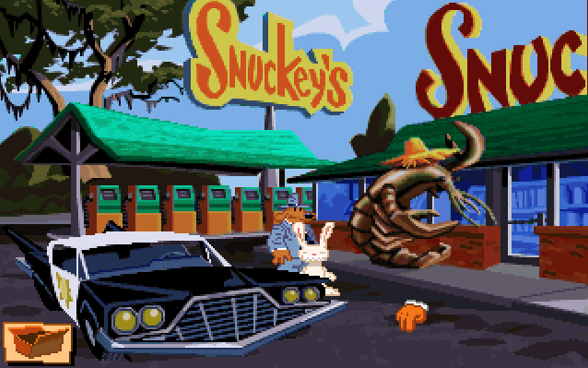
Sam & Max Hit the Road is a useful reminder of the LucasArts adventure-game grammar Star Wars never fully received: dialogue, absurd objects, visual jokes and puzzles built around curiosity. Screenshot source: MobyGames.
Where do we go from here?
The immediate future is already varied. Star Wars Eclipse is still built around Quantic Dream's branching narrative ambitions, while Lucasfilm Games now also lists Star Wars: Fate of the Old Republic, a narrative-driven action RPG, among its projects. Whatever ultimately reaches release, the current model leaves room for different studios to interpret Star Wars rather than forcing every game through the same template.
That should be the priority.
The lesson of the last thirty years is not that old Star Wars games were better than new ones, or that modern games have somehow misplaced the secret recipe. The lesson is that the strongest eras happen when developers are allowed to answer a simple question honestly: what kind of game should this Star Wars fantasy actually be?
Sometimes the answer is a role-playing game. Sometimes it is a flight simulator. Sometimes it is tactics. Sometimes it is racing. And one day, if the universe is feeling unusually generous, perhaps it will finally be a point-and-click adventure in which C-3PO spends twenty minutes trying to obtain the correct permit from an Imperial customs officer.
Star Wars does not need a game every month. It needs the next game to be allowed to surprise us.
About the author
Søren Ahrensborg Kamper is the editor of Star Wars: Gaming, an independent fan publication covering Star Wars games, history and design since 2009.
Related Stories:
Star Wars: Galactic Racer Official Launch Day Trailer
Star Wars: Galactic Racer Receives Perfect Scores Ahead Of Release
Star Wars Zero Company Out Today
Star Wars: Outlaws A New Open-World Star Wars Game Announced!
Star Wars: The Clone Wars Pandemic Game Launching October 1st!
Star Wars: Jabba's Palace – A Love Letter Game Now Available From Z-Man Games
New Star Wars Game Titles In Development
Star Wars Eclipse Game Announcement
Star Wars: Hunters Official Gameplay Trailer Drops
New LEGO Star Wars: The Skywalker Saga Gameplay Trailer
LEGO Star Wars: The Skywalker Saga Game Release Delayed
Star Wars: Hunters Video Game Just Revealed
The First Open-World Star Wars Game Confirmed
New Indiana Jones Game On The Way
Introducing Lucasfilm Games
* "Race" Relations (was "U.S. Society and Black Men")
* “So Say We All.” - The Battlestar Galactica Discussion Thread
* The Official NFL Discussion Thread
