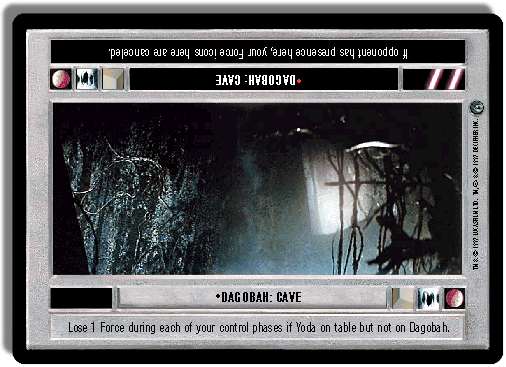
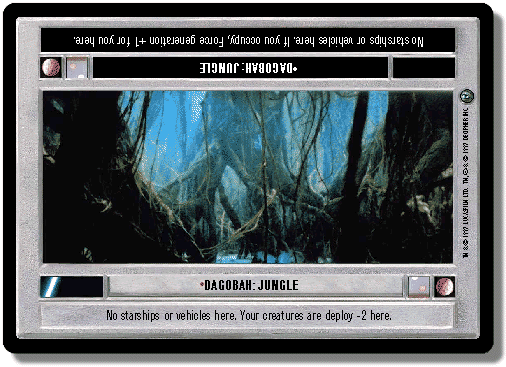
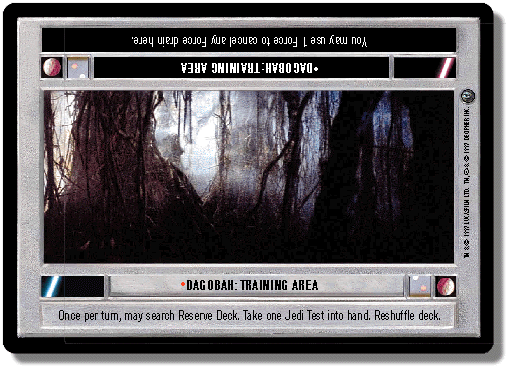
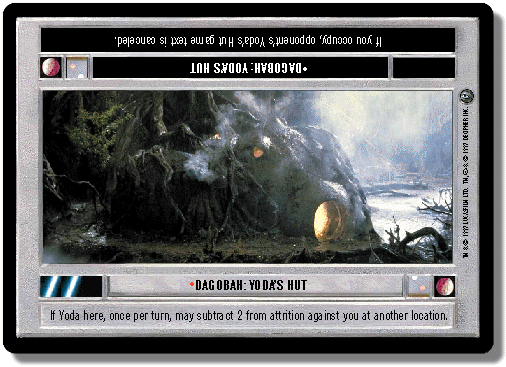
Dagobah
Location Deployment & Rules - Dagobah
locations deploy following normal deployment rules as follows:
The sparse population and extreme remoteness
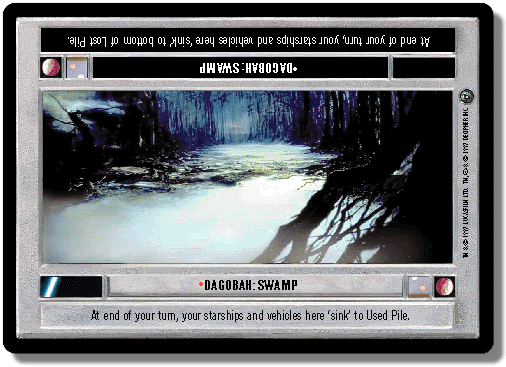
of the planet Dagobah make deployment to this system and its swampy landscape
unusually difficult. The thick atmosphere makes shuttling (and the use
of transport cards) impossible. Thus, special deployment and movement restrictions
apply to all Dagobah locations:
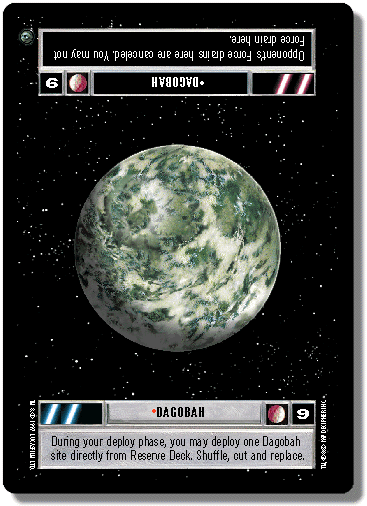
Characters, vehicles and starships may not deploy to Dagobah unless specifically
allowed by their game text (e.g., Yoda and Son Of
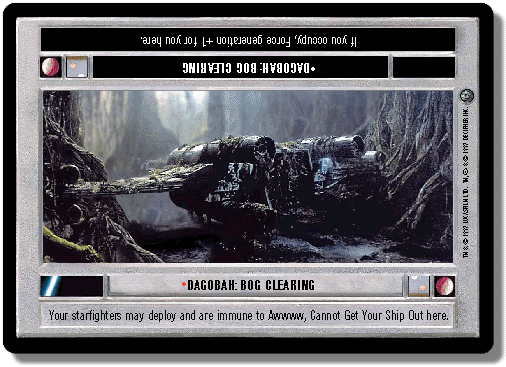
Skywalker) or another card (e.g., Encampment and Dagobah: Bog Clearing).
Devices and weapons may not deploy directly to Dagobah (but may deploy
on characters, vehicles and starships already there, if applicable).
Utinni Effects may not deploy to (or target a card at) Dagobah unless specifically
allowed by their game text.
Shuttling rules and transport cards (e.g., Nabrun Leids and Elis Helrot)
may not be used to move to or from Dagobah.
Creatures and all kinds
of Effects (except Utinni Effects) may deploy directly to Dagobah locations,
but they must obey any relevant deployment restrictions. Interrupts play
normally at Dagobah.
'So, how do I get my characters
and vehicles to Dagobah?' Normally you will use a card that allows this
(such as You Will Go To The Dagobah System) or you will deploy your characters
and vehicles elsewhere, then move them to the Dagobah system aboard a starship
that can land at a Dagobah site.
Sectors which
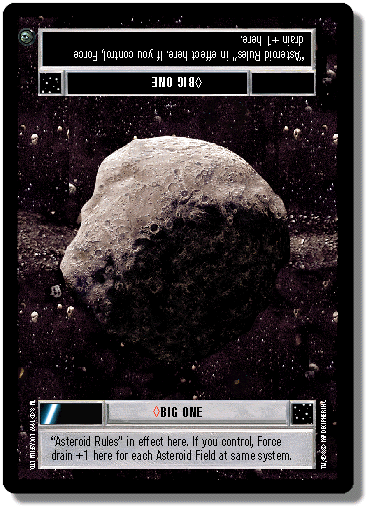
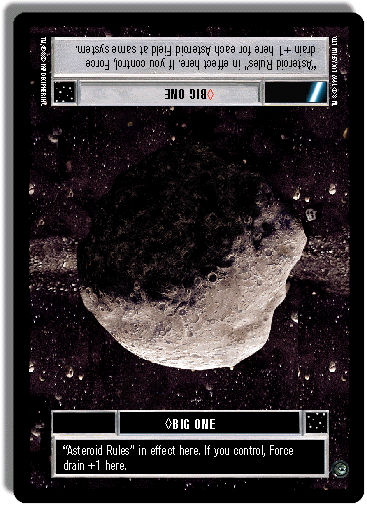
deploy to any planet system (i.e. Asteroid Field, Big One) may deploy only
where a system location is already on table.
At sector locations, you
may make any applicable 'reacts' and any applicable unlimited moves. In
addition, certain regular moves are allowed at sectors, depending on the
kind of sector (see asteroid sectors and cloud sectors).
Shuttling is NOT allowed at sectors.
Currently, the only sector
with a related site is the Big One.
Asteroid Sectors -
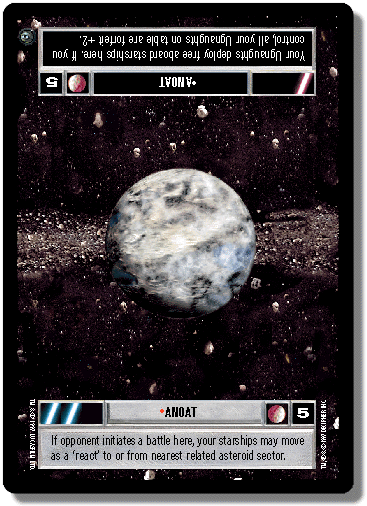
Asteroid sectors deploy to any planet system (even a 'blown away' planet
system). They are related to the system location, but not to the planet's
sites. They are not part of the planet and thus do not take on its name
(i.e., asteroid sectors at Dagobah are not 'Dagobah locations' and thus
are not affected by Dagobah's deployment restrictions). If the planet is
'blown away,' asteroid sectors there are not destroyed.
Capital starships and starfighters
may deploy, battle and move at asteroid sectors. Three types of regular
moves (each requiring 1 Force) are allowed:
System to sector -- A capital starship or starfighter may move from a planet
system location to the asteroid sector next to it (or vice versa).
Sector to sector -- A capital starship may move from one asteroid sector
to an adjacent asteroid sector. A starfighter may move up to two
asteroid sectors at a time (for 1 Force).
Sector to site -- A starfighter at a Big One sector may land at or take
off from the related Asteroid Cave or Space Slug Belly site.
Asteroid Rules -
Wherever 'Asteroid Rules' are in effect, your starships there are continually
subject to being hit by asteroids. During each of your control phases,
for each such starship:
Opponent draws one asteroid destiny (this is mandatory).
Add 1 for each additional sector at that system that has 'Asteroid Rules'
in effect. If total asteroid destiny > armor or maneuver, the starship
is lost.
If the card drawn for asteroid destiny is itself an asteroid sector, the
starship is lost, no matter how high its armor or maneuver.
Cave Rules - The
Big One: Asteroid Cave or Space Slug Belly site is a special location which
must deploy next to a Big One sector, as shown below:
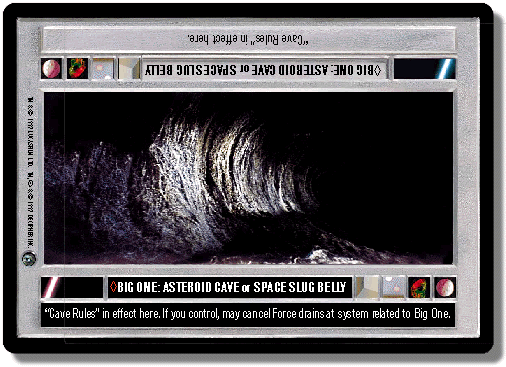
Normally this location is an asteroid cave (planet site). However, when
a Space Slug creature is present at the related Big One sector, the location
slides next to the Space Slug and becomes a space slug belly (creature
site).
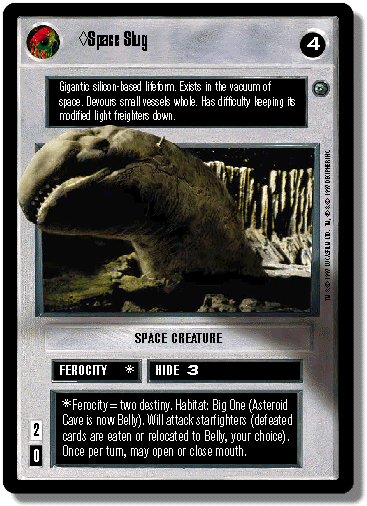
When this site is a belly, starfighters may not land or take off if the
Space Slug's mouth is 'closed' (as defined by the Space Slug's game text).
If the Space Slug is lost, all cards in the belly are also lost and the
site then slides next to the Big One, reverting to a cave. Whether the
site is a cave or a belly, it is always 'related' to the Big One, and characters,
vehicles and creatures may deploy there normally.
Attaching Creatures -
Instead of making an attack as normal, some creatures (e.g., vine snakes
and mynocks) attach themselves to a host. When attached, a creature does
not attack anything or move on its own, but instead moves automatically
with the host. Attaching creatures may be attacked by other creatures,
vehicles and characters present (and may be targeted by appropriate weapons)
even when they are attached. If a host is 'eaten' (by any creature), all
attached creatures detach. If a host is lost by other means, attached creatures
are lost with the host.
Special Notes:
Mynocks- In addition to attacking normally,
these creatures can attach themselves to a starfighter and chew on the
power cables ('meals'), draining power and reducing hyperspeed. (If they
detach, power and hyperspeed are restored.) Like other creatures, mynocks
may move from site to site, but they may also move like a starfighter (e.g.,
landing, taking off, and flying to and from sectors). Because mynocks have
no hyperspeed, to move from system to system they must 'hitchhike' on a
starfighter. Mynocks are not targeted like starships; however, you can
land your starfighter and clean them off with weapons that target creatures.
Vine Snakes- These creatures attach
themselves to a character, gradually squeezing the life out of their victim.
Vine snakes remain attached to their host even if the host moves out of
the creature's habitat. However, if a vine snake detaches outside of its
habitat, it is lost. Vine Snakes attack only characters, and thus they
ignore creatures and creature vehicles as potential meals. Vine snakes
will defend themselves if attacked.
Bombing Run -
This Mobile Effect defines a "target zone" and allows your piloted bombers
to move and battle there. Such bombers are not landed, but rather are conceptually
flying in the atmosphere (much like a snowspeeder). Their permanent pilots
have presence at the site and thus may block opponent's Force drains and
participate in battle, even if they do not carry Proton Bombs.
When a TIE Bomber begins
a Bombing Run by moving to a site, this is a regular move which requires
1 Force. The return trip to the system is a second regular move (even though
it occurs during the battle phase) which also requires 1 Force. If it is
not possible for the bomber to return to the system, it remains at the
site but is not considered landed. (As soon as it is possible for the bomber
to return at the end of one of your battle phases, it must do so -- even
if Bombing Run has been canceled.)
 Independent Starships - An independent starship
is privately owned and thus is neither Rebel nor Imperial. Cards that refer
specifically to 'Rebel' or 'Imperial' starships (such as Tallon Roll) do
not apply to independent starships.
Independent Starships - An independent starship
is privately owned and thus is neither Rebel nor Imperial. Cards that refer
specifically to 'Rebel' or 'Imperial' starships (such as Tallon Roll) do
not apply to independent starships.
Jedi Tests & Training -
A card type that allows you to train your characters on Dagobah in the
ways of the Force.
The Light Side can train
non-droid characters in the use of the Force using Jedi Test cards. Completing
Jedi Tests gives you new capabilities that can have far-reaching consequences,
and can also raise your character's ability. Attempting Jedi Tests involves
bringing an apprentice to a mentor on Dagobah and drawing training destiny.
Each Jedi Test card describes
how to begin, attempt and complete the test. The following rules apply
to Jedi Tests:
For every Dagobah site on table, you may add 1 to each training destiny
draw.
Each time an apprentice completes a Jedi Test numbered higher than that
character's ability, the ability number increases to match the
Jedi Test number. For example, completing test #4 raises the apprentice's
ability to 4.
A mentor may train only one apprentice at a time.
An apprentice may change mentors between Jedi Tests, if necessary.
An apprentice may not attempt a test that is already placed on that apprentice.
Once a character becomes an apprentice, that character's persona remains
an apprentice until becoming a Jedi.
A character may not be an apprentice and a mentor at the same time.
If a character is replaced by a different version of the same persona,
all benefits he or she earned from Jedi training apply to the new
version. This is also true if that character converts or crosses over to
the other side of the Force.
If a character is replaced
by a different version of the same persona, all benefits he or she earned
from Jedi training apply to the new version. This is also true if that
character converts or crosses over to the other side of the Force.
Landing Claw -
This device allows your starfighter to attach itself to an opponent's capital
starship. To indicate that your starfighter is attached, place it across
the table on the targeted capital starship card.
When attached, your starfighter
is conceptually concealed and thus it
does not participate in battles;
may not move on its own (and may not shuttle or transfer other cards);
may not have cards deployed on it;
may not be targeted by either player (e.g., by weapons, Interrupts, Utinni
Effects, asteroid destiny etc.); and
is treated as if it has no presence, yet still blocks your opponent's Force
drains.
If the capital starship
is lost, the attached starfighter is also lost.
Proton Bombs -
Proton Bombs deploy on your bomber. They can be used repeatedly in one
of two different 'bombing modes' depending on the kind of site being targeted:
Interior sites --
You may perform 'orbital bombardment' in an attempt to 'collapse' a related
interior site. Because the bombs are dropped
from orbit, the bomber does not move from the system. A related interior
site may not be targeted if it is protected by the Hoth energy shield.
Non-interior sites
-- You may perform 'carpet bombing' in an attempt to destroy characters,
vehicles and starships at a related non-interior site.
To accomplish this, the bomber briefly swoops down to the site by using
the Bombing Run Mobile Effect.
 Restricted cards - Some cards have one or
more diamond () symbols in
the card title. The number of diamonds indicates the number of copies that
both players together can have on table at any given system. (There is
no limitation on the number of systems where such a card may be used.)
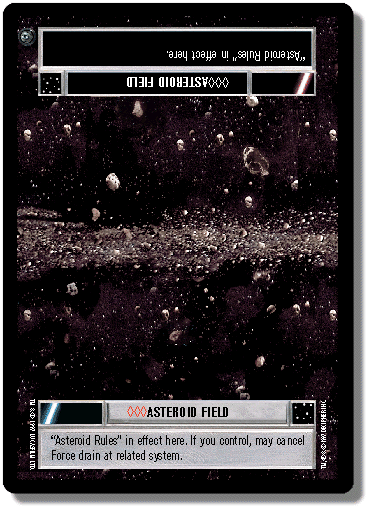
For example, the Asteroid field card has three diamonds().
Therefore, both players together are limited to a total of three Asteroid
Field locations at each planet system.
Restricted cards - Some cards have one or
more diamond () symbols in
the card title. The number of diamonds indicates the number of copies that
both players together can have on table at any given system. (There is
no limitation on the number of systems where such a card may be used.)
For example, the Asteroid field card has three diamonds().
Therefore, both players together are limited to a total of three Asteroid
Field locations at each planet system.
 Selective Creatures - Many of the smaller,
less ferocious creatures in the Star Wars universe are selective in their
eating habits and thus do not attack their own kind. Selective creatures
attack characters, creature vehicles or other species of creatures (those
with a card title different from their own and not of the same species).
However, selective creatures of the same species simply ignore each other
for purposes of attack.
Selective Creatures - Many of the smaller,
less ferocious creatures in the Star Wars universe are selective in their
eating habits and thus do not attack their own kind. Selective creatures
attack characters, creature vehicles or other species of creatures (those
with a card title different from their own and not of the same species).
However, selective creatures of the same species simply ignore each other
for purposes of attack.
Starship Sites -
Starship sites obey location deployment rules (e.g., interior/exterior
sequence and insertion) and create locations aboard a starship where characters
may deploy, battle and move.
For convenience, each group
of starship sites is placed on table separately from other sites. However,
the group is related to one particular starship (which must be specified
at the time of deployment).
Sites which are related
to a particular starship (e.g., Executor sites) may deploy even if that
starship is not on table (just as Death Star sites may deploy when a Death
Star is not on table). However, sites which work with any starship of a
given kind (e.g., Star Destroyer: Launch Bay) may deploy only to a starship
card already on table.
Characters at a starship
site are 'aboard the starship' but not 'present' at the bridge. Although
such characters participate normally in battles at these sites, because
they are below decks they may not use their game text to enhance the starship
card and they may not participate in starship battles (may not use power,
ability, game text or forfeit).
The player controlling
the starship may move his cards from a starship site to the related starship
card (capacity permitting), or vice versa. This movement requires 1 Force
per card and is a regular move.
If a starship is lost,
all related sites (and cards located at those sites) are also lost.
Special Note on Capacity:
Only characters which are
conceptually 'on the bridge' (or cockpit) take up capacity; those remaining
aboard something in the cargo bay, or currently at a vehicle or starship
site, do not occupy capacity and may not pilot, drive or otherwise enhance
the vehicle or starship.
Yoda - 'Notice
you will, on my card, an icon there is, yes. Jedi Master it means, and
a Light Side Force icon it includes. While on table am I, one extra Force
may you activate.'