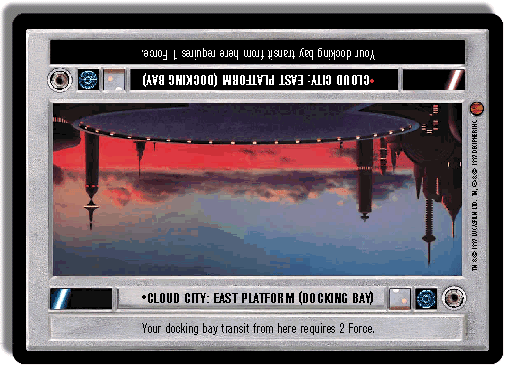
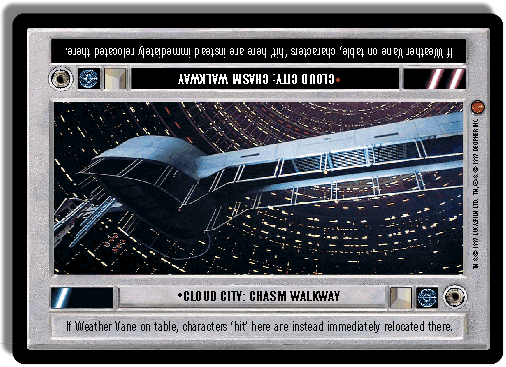
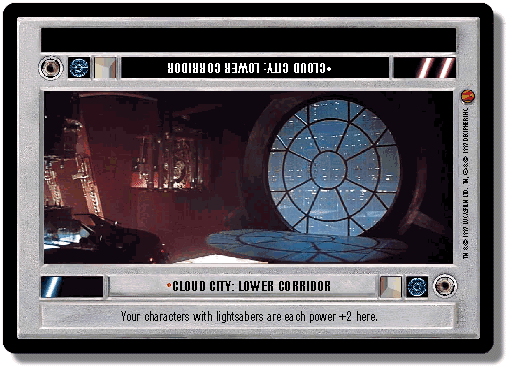
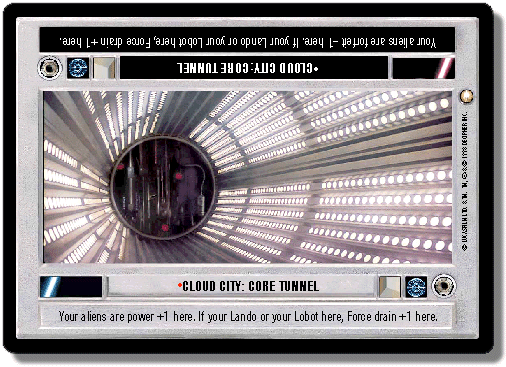
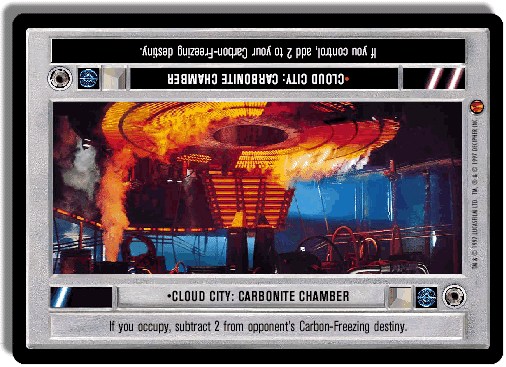
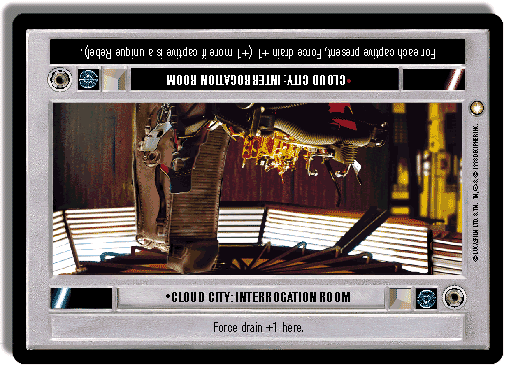
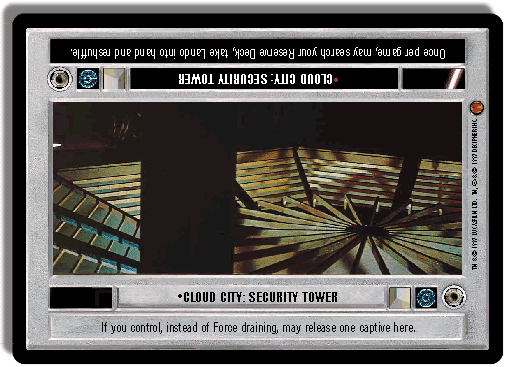
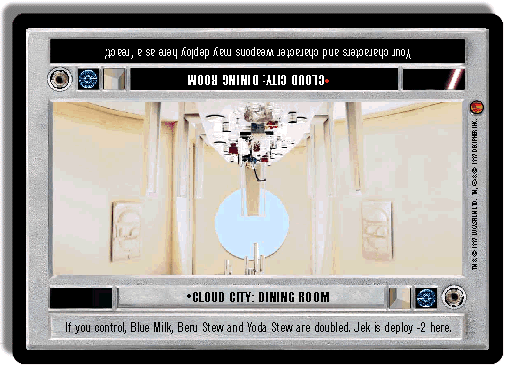
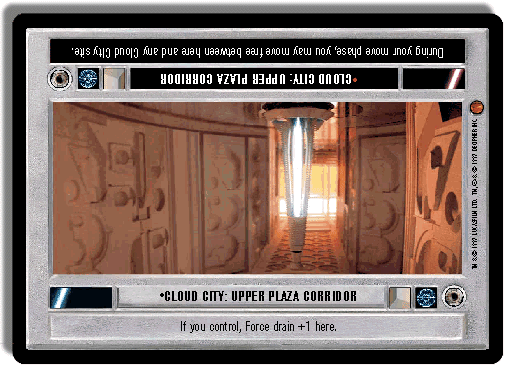
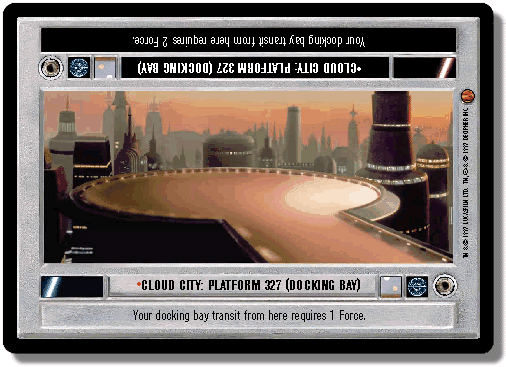

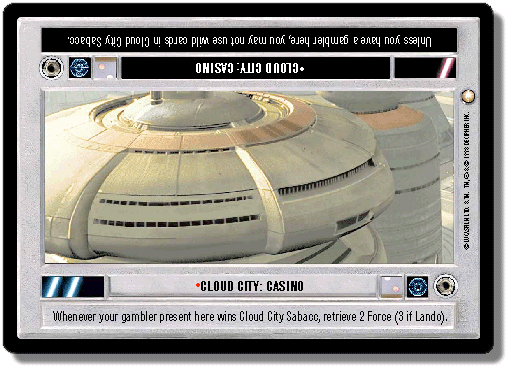
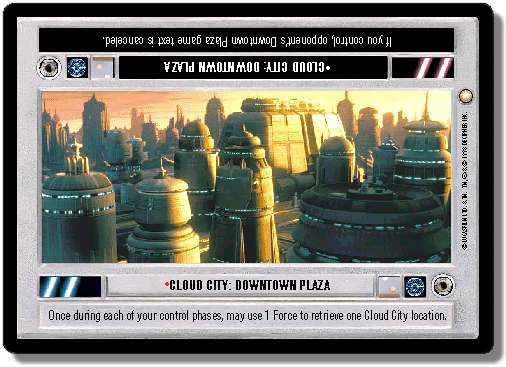
Exterior sites are placed between the first docking bay site (either East Platform or Platform 327) and the exterior sectors. If the second platform is deployed, it is placed at the ?far? end of the interior sites so there are docking bays at both ends of the interior Cloud City sites. You may use docking bay transit to go from one platform to the other.
Special Note:
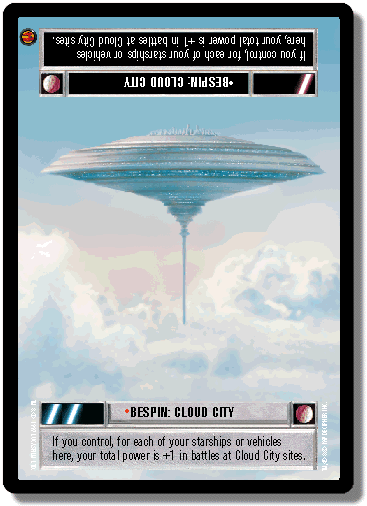
Bespin: Cloud City is a cloud sector,
but starfighters do not subtract 2 from power and maneuver as that
text is not listed on the location.
All sectors share the following features:
Sectors are oriented vertically, like systems; however, they have no parsec number and thus cannot be used for hyperspeed movement.
Vehicles and characters may not deploy or move to a sector unless aboard a vehicle or starship which is allowed at that sector.
Cards which affect starships at a system (i.e. Hyper Escape, Tallon Roll, and Collision) can also affect starships at a sector.
Cloud sectors (except Bespin: Cloud City) deploy next to any planet system or another sector of the same type, as shown below. Sectors may be inserted in any order, as long as you maintain the following pattern:
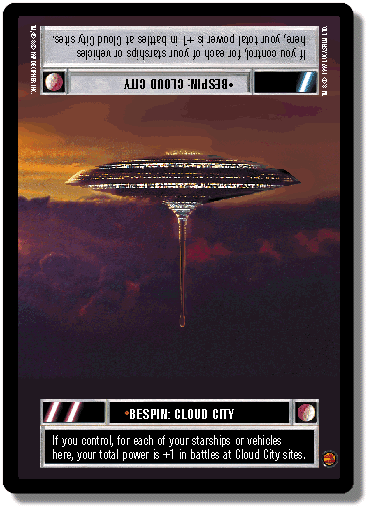
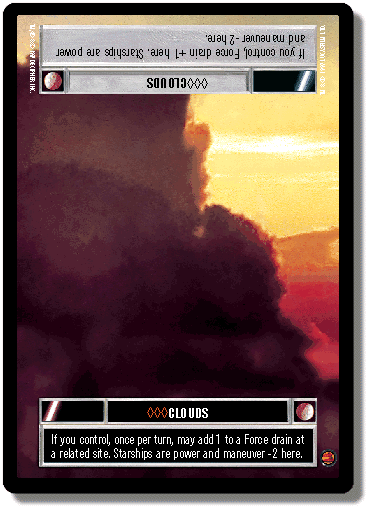
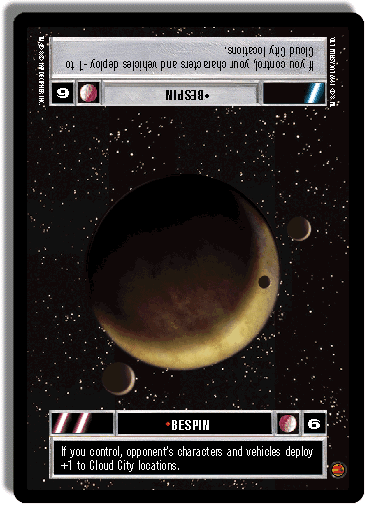
Sectors which deploy only to one particular
system (i.e. Bespin: Cloud City) may deploy even if that system location
is not on table. Sectors which deploy to any planet system (i.e.
Clouds) may deploy only where a system location is already on table.
At sector locations, you
may make any applicable 'reacts' and any applicable unlimited moves. In
addition, certain regular moves are allowed at sectors, depending on the
kind of sector (see asteroid sectors and cloud sectors).
Shuttling is NOT allowed at sectors.
Currently, the only sector
with a related site is the Big One.
Cloud sectors - Cloud
sectors deploy to any planet system (except a 'blown away' planet system).
They are placed between the system location and its related sites, and
represent various 'altitudes' of airspace above the planet's surface.
Starfighters, shuttle vehicles,
cloud cars and patrol craft may deploy, battle and move at cloud sectors.
(Capital starships, except those that deploy and move like a starfighter,
may not.) Three types of regular moves (each requiring 1 Force) are allowed:
System to sector -- A starfighter may move from a planet system location
to the cloud sector next to it (or vice versa).
Sector to sector -- Sector to sector - A starfighter, shuttle vehicle,
cloud car or patrol craft may move up to two cloud sectors at a time (for
1 Force).
Sector to site --Sector to site - A starfighter, shuttle vehicle, cloud
car or patrol craft at the lowest-altitude cloud sector (the one closest
to
the sites) may land at or take off from any related exterior site.
Cloud sectors effectively
increase the cost of landing, taking off and shuttling:
Starships may not land or take off directly between the system and its
related sites (they must 'fly through' the cloud sectors).
Each cloud sector cumulatively adds 1 to the cost of shuttling between
the planet system and its related sites.
Cloud sectors are related
to the planet system where they are deployed and to that planet's sites.
They are part of the planet and thus take on its name (i.e., cloud sectors
at Tatooine are Tatooine locations, effectively becoming 'Tatooine: Clouds').
If the planet is 'blown away,' cloud sectors there are destroyed (lost).
Light Side may not use the capturing portion of that card. There are even some objective cards though that allow the Dark Side player to sta rt the game with a captive (for example, Carbon Chamber Testing or the Light Side objectives Rescue The Princess and You Can Either Profit By This...). The Dark Side may capture only Light Side cards. (However, both players can steal the opponent?s cards, which is different from capturing.)
Whenever a rule or card says that a character is captured, the Dark Side player must immediately choose one of these three options:
Seizure ? Your bounty hunters and/or warriors at the same location may seize (take into custody) one of the captured characters each;
that character is now a captive and is placed face up beneath the bounty hunter or warrior who is now it's escort. See captives ? escorting.
Imprisonment ? If the capture takes place at any prison, you may imprison any number of the captured characters there; those
characters become a imprisoned captives and are placed face up beneath that prison. See captives ? imprisoned.
Escape ? Any characters not seized or imprisoned will escape to the Light Side player?s Used Pile.
A captured character is on table only for rules, actions, or conditions that specifically refer to captured cards. Additionally, a unique (?) or restricted (??, ???) captured character still counts towards the restrictions specified by the uniqueness and persona rules.
Any captive may be affected by text that specifies "all cards" or "all characters" because these cards do not "choose" the captive as a target. For example, a captive may be lost to TIE Bombing, a Thermal Detonator, a Concussion Grenade, or an interrupt such as Debris Zone. See all cards. It should be noted that an imprisoned character is treated a little differently. See captives - imprisoned.
For all other purposes, a captured card is not considered to be on table .
Any non-character cards deployed on or carried by a character who is captured will continue to count towards the restrictions specified by the uniqueness and persona rules, but are otherwise not considered to be on table. They are unusable and cannot be the subject of any other rule, action or condition. The exception to this is any cards that specifically operate while on a captive (for example, Bounty) which will continue to work normally. These cards will revert to their normal functions if that character is later released.
Any character card being carried by a character that is captured (for example, Yoda is in Luke's Backpack when Luke is captured by IG - 88's Riot Gun) is considered to be captured also, but is no longer considered to be "carried." Both captives would need to be assigned to different escorts and both would need to be rescued individually.
Utinni Effects that targeted a captive before that character became captured continue to target that character normally. An uncompleted Jedi Test will "remember" a captured apprentice (or mentor) such that if released, the apprentice (or mentor) may resume Jedi Training from where he or she left off. See captives ? frozen.
Captives--escorting:
When your bounty hunter or warrior takes a captive into custody (including by prisoner transfer) the bounty hunter or warrior becomes that captive?s escort. Each character may escort only one captive at a time. Unless specifically allowed by a card, an escort may not give its captive to another bounty hunter or warrior.
A captive moves with its escort automatically (at no additional use of the Force) whenever the escort uses landspeed, shuttling, docking bay transit, embarks, disembarks , transfers between docked starships or uses the special movement text of a site location (for example, Cloud City: Upper Plaza Corridor). The captive occupies passenger capacity aboard vehicles and starships (regardless of whether the escort is a passenger or a pilot).
Captives--imprisoned:
An imprisoned captive
should be treated as if 'enclosed' within that prison, and is not present
with any other characters, vehicles, weapons or devices at that prison
location. In addition, an imprisoned character is unaffected by "area affect"
cards such as a Thermal Detonator or Program Trap, but can be lost to cards
that 'destroy' the entire prison location such as by blowing away the planet
or collapsing the prison.
Captives--frozen:
This term refers to a captive
who is encased in carbonite (via a Dark Side card such as Carbon-Freezing
or All Too Easy, or the Light Side Objective card You Can Either Profit
By This... / Or Be Destroyed).
A frozen captive is considered
to be power, ability, and landspeed = 0 for any action or condition that
targets these statistics of a captive.
A frozen captive:
cannot be atta cked by creatures (not even with the game text on Great
Pit of Carkoon)
cannot be tortured or interrogated in any way (using IT-0, Hypo, EV-9D9,
Aiii! Aaa! Agggggggggg!, Interrogation Array, Sonic
Bombardment and Cloud City: Interrogation Room).
cannot be "hit", and cannot battle or fight their escort, so they cannot
be used with Captive Fury, Human Shield, or Strangle.
cannot be escorted with Binders.
cannot be targeted by any card that freezes a character.
Otherwise, a frozen captive
is on table only for rules, actions, or conditions that specifically refer
to captives or frozen captives. Additionally, a unique (?) or restricted
(??, ???) frozen captive still counts towards the restrictions specified
by the uniqueness and persona rules.
Captives--prisoner transfers:
During the Dark Side's
move phase, the Dark Side player may perform any of the following "prisoner
transfers." These are unlimited moves for both the escort and the captive:
An escort present at a prison may transfer (deliver) its captive to that
prison. Place that captive face-up below the prison. That captive is
'delivered' and is 'imprisoned'. See captives ? imprisoned.
A bounty hunter or warrior present at a prison may take a captive imprisoned
there into custody. See captives ? escorting.
An escort present at any site may leave a frozen captive he is escorting
at that site. That frozen character is now "unattended" and is no
longer considered to be escorted. See captives ? frozen.
An unattended frozen captive may be taken into custody by any Dark Side
bounty hunter or Dark Side warrior present. See captives ? escorting.
Captives--releasing:
When your characters are
captives, you may release them using cards such as 8D8, Arc Welder, Captive
Pursuit, Cell 2187, Detention Block Control Room, I?m Here To Rescue You,
Jedi Mind Trick and Someone Who Loves You, as well as the Light Side game
text of your opponent?s Cloud City: Security Tower or Jabba?s Palace: Dungeon.
Whenever a non-frozen captive
is released from an escort by any means (such as by a special card, or
by the escort becoming lost, removed from the table, or missing), the Light
Side player may choose whether the released character:
be placed in the Light Side player's Used Pile or
if released at a site, be moved to the Light Side of the site location
A captive released from
a prison m u s t be moved to the Light Side of that prison location. See
captives
? frozen ? releasing.
Captives--frozen--releasing:
Frozen captives may be
released by special cards or game actions that release captives (see captives
? releasing). In addition, if the Light Side controls a location where
an unescorted frozen captive is (and that captive is not imprisoned), then
that captive may be released. A frozen captive released from carbonite
must be moved to the Light Side of that location if at a site (or may be
placed in the Light Side players Used Pile if not at a
site).
A character who crosses to your side conceptually takes on a new identity, just as Anakin Skywalker gave in to the Dark Side and became Darth Vader. Your opponent may not deploy any more copies of that persona for the rest of the game. Also, any cards which affect that character by name do not apply (lose any such cards deployed on or targeting the character at the moment of crossing over).
For example, if Luke loses an Epic Duel and crosses over to the Dark Side, cards such as Don't Get Cocky and Run Luke, Run! no longer work because the name 'Luke Skywalker' no longer has any meaning for him, and I Have You Now no longer works because he's neither Luke nor a Rebel any more. Also -- like his father before him -- he will abandon Anakin's Lightsaber because it works only on a Skywalker. On the other hand, he could still use Luke's Blaster Pistol because it works on any warrior, although he would not get any benefit from the Luke-specific portion of the blaster pistol's game text.
When a character crosses over to the Dark Side, the benefits of any Jedi Tests that character has completed apply to the Dark Side player.
If Luke With Lightsaber is crossed to the Dark Side he is still capable of using his permanent weapon (as it is simply character game text).
Lando and the Tonnika Sisters do not 'cross over,' they convert (see converting characters).
Lando and Lobot - These
personas have both a Light Side and Dark Side version. Accordingly, some
cards may target 'your Lando/Lobot,' while others target 'opponent's Lando/Lobot'
and still others may target 'any Lando/Lobot.' Because Lando and Lobot
are unique, only one player may have either of them on table at a time.
As the Dark Side player,
you can exploit Dark Side Lando and Lobot in many powerful ways. However,
they have a weakness. '[They've] got no love for the Empire' and thus are
vulnerable to being replaced by Light Side Lando or Lobot during your opponent's
deploy phase. The Cloud City deployment restriction does not apply (Lobot
must still deply as a 'react'), but otherwise their conversion must follow
the normal the rules for persona replacement (any cards deployed on or
targeting Lando/Lobot transfer to the Light Side version, if applicable,
and Dark Side Lando/Lobot goes to the Lost Pile).
When any Lando/Lobot is
placed out of play, the persona rules prevent any other Lando/Lobot from
coming into play for the remainder of the game.
 Permanent Weapon -
This icon represents a character weapon that
may not be separated from the character (lost, stolen, transferred, retrieved
etc.) except by cards that deploy on the character as a marker (e.g., Disarmed).
If such a marker card is removed, the weapon is restored.
Permanent Weapon -
This icon represents a character weapon that
may not be separated from the character (lost, stolen, transferred, retrieved
etc.) except by cards that deploy on the character as a marker (e.g., Disarmed).
If such a marker card is removed, the weapon is restored.
Game text that relocates
weapons (e.g., to or from a pile) may not be used to relocate this character
card, unless that game text also relocates characters.
If the game text of a character
with a permanent weapon is cancelled or suspended, that character is still
considered to be in possession of the weapon that is specified within the
character's game text.
'Scanning' or copying the
game text of a character with a permanent weapon does not enable the scanning
character to use that weapon, and the scanning character is not considered
to be possessing that weapon.
A permanent weapon is considered
to be a matching weapon only if the character's name (or persona name)
is contained in the title of that weapon.
Sabacc Rules - In
the Star Wars universe, sabacc is a high-stakes card game commonly played
by gamblers, cutthroats and other rough characters. Many different variants
exist throughout the galaxy. The Star Wars Customizable Card Game allows
you and your opponent to play sabacc as a 'side game' by using special
sabacc Interrupt cards. The following rules apply to all sabacc variants.
The object of the game
is to draw two to six sabacc cards which have a total value as close to
11 as possible (without going over). To initiate sabacc, you must target
one of your characters that meets the requirements on the sabacc Interrupt
(it is not necessary for an opposing character to be present; conceptually,
your character can play against an unseen adversary). Your opponent may
also target one of his characters if he has one who meets the requirements.
For example, in Cloud City Sabacc, targeting a gambler can be helpful to
either player.
Both players temporarily
set aside their regular hands while playing sabacc.
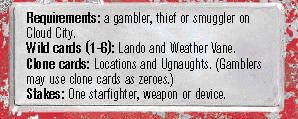
Playing sabacc -- Each player draws
the top two cards from his Reserve Deck (sabacc cannot be initiated unless
this is possible). Players may then choose to draw additional cards. Beginning
with your opponent, each player in turn may either draw a card or 'pass.'
(A player must pass if he has no cards remaining in his Reserve Deck or
if he already has six cards in his sabacc hand.) After a player passes,
that player may not draw any more sabacc cards.
Each card's value is equal
to its destiny number, except for wild cards and clone cards (which are
defined on the sabacc Interrupt):
Each
wild card must be assigned a value within the range shown on the sabacc
Interrupt. (You may choose a different value for each of
your wild cards.)
Each
clone card must 'clone' (duplicate) the value of any other card in that
hand (even a value assigned to a wild card). A hand
containing nothing but clone cards has a total value of zero.
Players choose the values
of their wild cards and clone cards (if any), then reveal their entire
sabacc hands to determine the winner.
The player
who is closest to 11 (without going over) wins.
If both players go over, the player who is closest to 11 wins.
In the case of a tie, the player with the fewest sabacc cards wins. (If
players also tie for number of sabacc cards, the game is a draw -- there
is no winner or loser.)
The loser must give up
one sabacc card as follows:
If any cards in the loser's sabacc hand are listed among the stakes, the
winner chooses one such card and places it in his Used Pile as if
stolen (see stealing).
Otherwise, the winner chooses any card there to be lost.
All remaining sabacc cards are then placed
in their owners' Used Piles and regular gameplay resumes.
Perfect sabacc -- If a player's first
two sabacc cards total exactly 11 (with no wild cards or clone cards),
that player announces 'sabacc!' and immediately wins double: the loser
must give up each of his two sabacc cards (stakes to the winner's Used
Pile; others to the loser's Lost Pile). If both players have a perfect
sabacc, the game is a draw.
Each hand of sabacc is
a single action initiated by the play of the appropriate Interrupt card.
Sabacc may not be initiated during battle.
Sabacc draws are not destiny
draws, and thus do not trigger the game text of cards such as R2-D2 or
Tauntaun Bones.
Apply all standard modifications
to the destiny numbers of cards drawn during sabacc. For example, conditions
at Kiffex could cause the Tonnika Sisters card to have a sabacc value of
four.
Your sabacc hand is considered
part of your Life Force. As such, cards from your sabacc hand may be lost
to satisfy required Force losses that might occur during sabacc (such as
from an 'insert' card).
When the Light Side player
wins an Imperial starship as a stake in sabacc, that starship becomes a
Rebel starship (and vice versa).
If you use Lando's game
text to modify your total, you cannot have a perfect sabacc.